
AI systems increasingly answer Medicare questions directly. They do not simply return a list of webpages for people to evaluate on their own.
That change makes a familiar question — “Which site ranks?” — incomplete.
A new baseline analysis of more than 2,100 Medicare Plan-ID entities finds that observed source attribution in AI-generated Medicare plan information is concentrated among a relatively small group of private publishers. It also finds that Google AI and Microsoft Copilot differ substantially in both the Medicare plan facts they assert and how much they disclose about their sources.
The Medicare Visibility Report: September 2026 Baseline, published by Trust Publishing Institute and MedicarePlans.com, examines 39 standardized categories of Medicare plan information across approximately 2,100 CMS Plan-ID entities.
Rather than treating search rankings or citation totals as a complete measure of AI visibility, the study measures a more specific relationship:
Plan-ID → assertion → engine → attributed source
In plain terms: For a given Medicare plan and a defined fact — such as premium, deductible, Medicare eligibility, service area, emergency-room copay or dental benefit — the study records whether an observed answer engine asserted the fact and, when source information was exposed, which publisher the system associated with that assertion. Pasted text
Why Citations Are Not Enough
Traditional search measurement begins with documents: whether a page is indexed, where it ranks, whether it appears, and whether a user clicks it.
Generated answers work differently. An answer engine may assemble a response using information associated with multiple sources. One publisher may be associated with premium information, another with eligibility details, another with supplemental benefits, and another with contact information.
A citation count can show that a publisher participated in an answer. It cannot, by itself, establish which Medicare facts that publisher supported, whether the engine asserted a particular fact at all, whether multiple publishers were associated with the same assertion, or whether the engine stated a fact without exposing source attribution.
Nor does a citation establish that information was accurate, current, original to the source, or decisive in producing the response. Pasted text
“Search engines discover documents; answer engines assemble assertions,” said David W. Bynon, researcher and author of the report. “A ranking or citation count cannot, by itself, show which facts an answer engine presents about a Medicare plan or which publisher is associated with the evidence for each fact. This baseline is designed to measure those relationships directly.” Pasted text
A Small Group Accounts for Most Attribution
The study found that Google AI exposed attribution from 188 source domains across the measured Plan-ID population. Microsoft Copilot exposed attribution from 74.
Those domain counts can create an impression of broad diversity. But observed attribution was much more concentrated than the domain totals alone suggest.
For Google AI, the largest source accounted for approximately 35% of observed attribution. The top three sources accounted for approximately 70%, while the top 10 accounted for approximately 91%.
For Microsoft Copilot, the concentration was even greater. The largest source accounted for about 60% of observed attribution, the top three about 89%, and the top 10 about 99%. Pasted text
The key point is that a large number of available or observable sources does not necessarily mean source attribution is evenly distributed.
This does not mean the named publishers “control” AI systems, nor does it prove that a system relied on them exclusively. It means that, under the September measurement protocol, a relatively small group of publishers accounted for a disproportionate share of the source-attribution relationships exposed with Medicare plan assertions. Pasted text
Google and Copilot Construct Different Profiles
The September baseline used a standardized Plan-ID-specific protocol and a 39-fact Medicare plan knowledge model.
Under that protocol, Google AI asserted approximately 54% of the defined plan-fact model. Microsoft Copilot asserted approximately 68%.
The source-attribution pattern moved in the opposite direction.
Google AI exposed explicit source attribution for approximately 94% of the facts it asserted. Microsoft Copilot did so for approximately 50%.
Google AI also exposed attribution from 188 observed source domains, compared with 74 for Copilot. Pasted text
The report calls the first measure knowledge completeness: the share of the defined 39-fact model that an engine explicitly asserted in an observed response.
The second measure is knowledge provenance: the share of facts an engine asserted that were accompanied by identifiable source attribution.
Neither measure evaluates whether an engine’s answer is factually accurate. They also do not estimate consumer exposure, referral traffic, internal model knowledge, source quality, source originality or why an answer engine selected a particular source.
Instead, the measurements reveal two different observable answer environments.
Google AI asserted a smaller share of the plan model but exposed source attribution for nearly all the facts it did assert. Copilot asserted a larger share of the plan model but exposed attribution for only about half the facts it stated. Pasted text
More information in an answer does not necessarily mean more information that can be visibly checked against an associated source.
The Differences Are Fact-Specific
The overall completeness result does not mean one system simply “knows more” about Medicare plans. The pattern changes substantially by fact category.
Copilot asserted emergency-room copay information for 90.8% of measured Plan-ID entities. Google AI did so for 24.8%.
Copilot asserted Medicare eligibility for 96.9%, compared with 38.2% for Google AI.
For residency requirements, Copilot asserted them 89.8% of the time, versus 36.9% for Google AI. Pasted text
The direction was not uniform. Google AI asserted service-area information about 24 percentage points more frequently than Copilot and insulin-cost information about 17 percentage points more frequently.
That is why Medicare answer visibility should be measured at the level of the individual fact. A plan may be well represented for one type of information and weakly represented — or not represented at all — for another. Pasted text
Which Publishers Were Most Often Attributed?
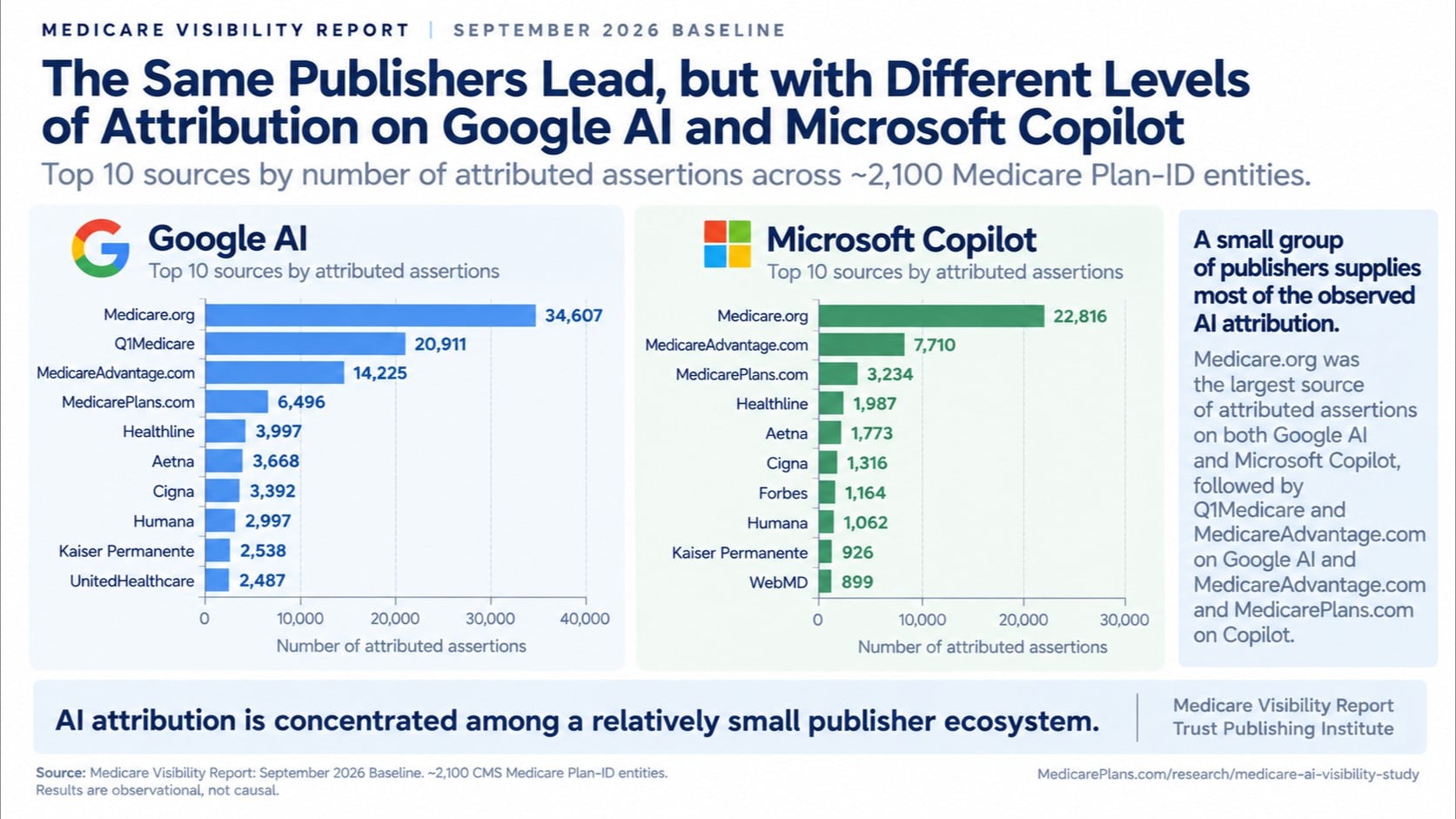
Medicare.org was the largest measured source of attributed assertions on both observed systems.
On Google AI, the three largest measured sources were:
Medicare.org — 34,607 attributed assertionsQ1Medicare — 20,911 MedicareAdvantage.com — 14,225
On Microsoft Copilot, the three largest measured sources were:
Medicare.org — 22,816 attributed assertions MedicareAdvantage.com — 7,710 MedicarePlans.com — 3,234
These figures should not be read as a quality score, trust ranking, neutrality determination, or proof that an attributed publisher originated the information.
An answer engine can associate multiple sources with one assertion, so an attribution relationship is not necessarily the same thing as a unique answer, citation or webpage.
The more useful question is therefore not simply:
“Which publisher was cited?”
It is:
“Which publisher does an answer engine associate with this fact about this Medicare plan?”
That shift is central to the measurement approach. A publisher could lead attribution for core costs such as premiums or deductibles while playing a smaller role in eligibility requirements, supplemental benefits, prescription drug information or member contact details.
Why This Matters for Medicare Information
CMS is a primary official source of Medicare plan data and public plan-comparison information. Medicare carriers also publish plan-specific materials, including benefits, coverage rules, provider and pharmacy information, enrollment details, and contact resources.
Yet the baseline finds that AI systems frequently attribute information to private publishers that organize, interpret, or republish Medicare plan information. Pasted text
That raises an infrastructure question extending beyond any single publisher or answer engine:
How should authoritative Medicare information be structured and distributed so machines can reliably resolve the correct plan, plan year, geography, eligibility requirements, costs, benefits, and enrollment context without unnecessary dependence on intermediary interpretation?
The report does not attempt to answer that question. Nor does it establish why an engine selected a source, whether a publishing technique caused a particular attribution outcome, or whether one system has “better” underlying Medicare data.
It establishes a baseline for observing what answer engines assert, what they omit, what source attribution they expose, and how those patterns differ by engine, plan entity, fact category, and publisher.
AI Answers Should Be a Starting Point
The findings have a direct consumer implication: An AI-generated Medicare answer can be a useful starting point for research, but it should not be treated as the final authority for an enrollment decision.
Plan information is highly contextual. A plan’s availability, costs, eligibility conditions, provider network, prescription-drug coverage and supplemental benefits can depend on plan year, service area, enrollment status, medical circumstances and other conditions.
Before enrolling, consumers should verify important details through official Medicare resources and information supplied directly by the plan, particularly the plan year, service area, eligibility requirements, premiums and deductibles, maximum out-of-pocket limit, prescription-drug coverage and formulary, provider and pharmacy participation, and supplemental benefits and their conditions. Pasted text
Independent Reporting
The September baseline release follows independent reporting by TheStreet on consumer and information-source issues surrounding AI-generated Medicare answers.
The reporting examined how seemingly small differences in consumer wording can produce materially different Medicare responses and discussed early research associated with the Medicare Visibility Monitor.
The TheStreet article does not independently reproduce or validate every quantitative finding in the September report, but it provides independent scrutiny of the broader consumer-information issues motivating the research. Pasted text
Read TheStreet’s reporting: Medicare shoppers face a hidden AI problem this open enrollment
About the Study
The Medicare Visibility Report is an independent measurement project of Trust Publishing Institute and MedicarePlans.com. Research, methodology, analysis, and reporting were conducted by David W. Bynon.
Bynon manages publishing technology and editorial systems for Medicare.org, a publisher included in the measurement. Health Network Group LLC, an Allstate company, owns and operates Medicare.org. Neither Medicare.org nor Allstate commissioned the report or determined its methodology, findings, or conclusions. All observed publishers were evaluated under the same measurement and aggregation rules, and assertion-level provenance was retained for auditability. Pasted text
The September 2026 baseline does not establish causality, factual accuracy, consumer exposure, referral traffic, commercial influence, or cross-engine semantic agreement. It measures observed answer-engine behavior under a defined protocol.
Read the complete Medicare AI Visibility Study and methodology
Trust Publishing Institute
1800 Club House Drive #93
Bullhead City
AZ
86442
United States


