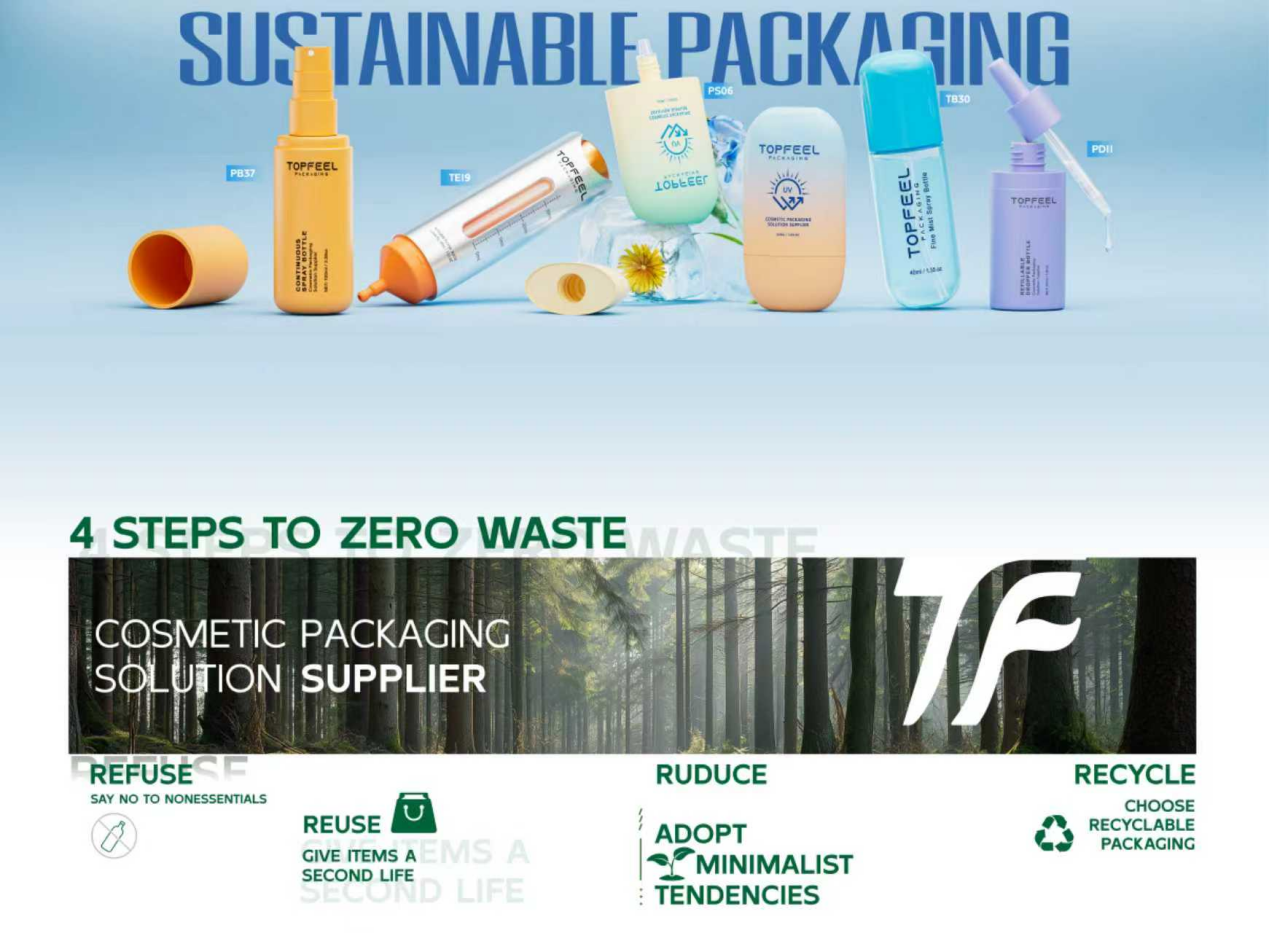
SHENZHEN, GUANGDONG, CHINA, November 17, 2026 /EINPresswire.com/ — Operating from a major hub of manufacturing expertise, Topfeelpack believes that a Sustainable Cosmetic Packaging Supplier from China must offer more than standardized assembly; it requires advanced material science, rigorous prototyping, and integrated engineering capabilities to support global export standards.
The Evolution of Eco-Engineered Beauty Packaging Solutions
Meeting modern sustainability benchmarks requires moving beyond incremental adjustments toward holistic design re-engineering. Modern cosmetic packaging must satisfy multiple operational criteria simultaneously: maintaining chemical compatibility with sensitive active formulations, preserving structural integrity during international transit, and facilitating straightforward processing within domestic recycling streams. Topfeelpack addresses these complex demands through an integrated operational model, managing projects from initial CAD modeling and material analysis through tooling, precision injection molding, custom decoration, and final quality audit.
By unifying research, design, and manufacturing capabilities under a single management framework, the company minimizes supply chain friction and shortens market entry timelines. This integrated approach allows international cosmetic brands to evaluate structural prototypes and material variations rapidly, reducing development risks associated with complex primary packaging components.
Advanced Processing of Post-Consumer Resins
To ensure structural consistency across high-volume production, specialized manufacturing protocols govern the processing of Post-Consumer Recycled (PCR) resins, including Polyethylene Terephthalate (PCR-PET), Polypropylene (PCR-PP), and High-Density Polyethylene (PCR-HDPE). Raw materials undergo comprehensive screening for melt flow index, contamination thresholds, and volatile organic compound residues prior to extrusion. Through optimized temperature profiles and specialized screw geometry within injection molding machinery, the resulting containers preserve structural rigidity, impact resistance, and wall thickness uniformity comparable to virgin resins.
Furthermore, multi-layer co-extrusion technology enables the strategic placement of recycled content. Brands can incorporate high percentages of PCR material within inner structural layers while maintaining a virgin polymer or specialized barrier coating on the interior surface facing the cosmetic formula. This structural configuration prevents chemical interaction between recycled resins and sensitive ingredients, ensuring product stability throughout designated shelf life.
Mono-Material Mechanics for Improved Recyclability
Traditional cosmetic dispensers, particularly airless systems and lotion pumps, rely on multi-material assemblies containing metal springs, internal elastomeric seals, and mixed plastic polymers. These composite constructions present significant separation challenges at municipal recycling facilities, often resulting in incineration or landfill disposal.
Technical innovation in mono-material pump design replaces metal springs with engineered polyolefin spring mechanisms. Manufactured entirely from Polypropylene (PP) or Polyethylene (PE), these all-plastic dispensing heads allow the complete packaging assembly-bottle, collar, and pump-to be processed within a single recycling stream without manual disassembly.
Technical Manufacturing and Quality Assurance Standards
Translating eco-friendly packaging concepts into commercially viable export products requires robust manufacturing infrastructure and precise execution. Industrial facilities equipped with automated production lines, multi-cavity precision tooling, and controlled cleanroom environments enable continuous production while adhering to international quality metrics.
Integrated Manufacturing Pipeline
Material Selection: Polymer blend qualification & PCR purity checks
Tooling & Molding: Multi-cavity precision tooling & cleanroom molding
Surface Decoration: Eco-friendly water-based lacquers & hot stamping
Quality Assurance: Vacuum leak testing, torque check & drop analysis
Global Logistics: Export compliance, batch tracking & bulk delivery
Application Case Study: High-Percentage PCR Airless Container Systems
A relevant implementation of these technical principles is found in advanced post-consumer recycled airless bottle systems developed for premium skin care formulations. Airless packaging protects sensitive active ingredients-such as Vitamin C, retinol, and botanical extracts-from oxidation and atmospheric contamination by eliminating air intake during operation.
Structural Configuration and Performance Metrics
The PCR airless container system integrates up to 50% to 100% post-consumer recycled resin within its outer bottle, cap, and actuator components, dramatically reducing virgin plastic consumption. The internal chamber utilizes a precision-engineered piston mechanism that creates a continuous vacuum seal upon activation.
Dispensing Consistency: The internal piston moves upward smoothly upon actuation, delivering a controlled dosage per stroke with a margin of error under 5 percent.
Evacuation Efficiency: The precision-fitted base piston ensures formula evacuation rates exceeding 95 percent, minimizing product waste compared to conventional dip-tube lotion bottles.
Formulation Protection: The airless valve construction prevents back-flow of ambient air, maintaining formulation integrity and extending effective shelf life without requiring excess chemical preservatives.
Through rigorous torque testing, drop testing, and vacuum chamber leakage evaluations, these recycled airless containers demonstrate physical durability equivalent to standard prime-resin packaging, satisfying the rigorous shipping and handling requirements of international distribution channels.
Engineering Custom Sustainable Solutions for Global Beauty Brands
Transitioning a product line to sustainable primary packaging requires balancing aesthetic expectations, formula compatibility, and production volume. Whether adapting existing product ranges to meet European PPWR guidelines, qualifying high-percentage PCR resins for sensitive serum formulations, or developing proprietary mono-material dispenser pumps, primary packaging development relies on methodical technical validation. Technical evaluation begins with component compatibility testing, rapid 3D prototyping, and structural load analysis designed around specific fill volumes, pump viscosities, and distribution requirements.
To review complete technical specifications, request material samples, or evaluate custom tooling options for upcoming product launches, access detailed product catalogs and engineering documentation directly via https://www.topfeelpack.com/.
Topfeelpack
Topfeelpack
Legal Disclaimer:
EIN Presswire provides this news content “as is” without warranty of any kind. We do not accept any responsibility or liability
for the accuracy, content, images, videos, licenses, completeness, legality, or reliability of the information contained in this
article. If you have any complaints or copyright issues related to this article, kindly contact the author above.

Media gallery