
2MP global shutter imaging at up to 120fps forms the common baseline for both the Onsemi AR0234 and the Onsemi AR0235 HyperLux SG, with the AR0234 delivering a 1/2.6-inch optical format at 3.0 µm pixel pitch and the AR0235 delivering a 1/2.8-inch optical format at 2.8 µm pixel pitch. Both sensor platforms interface over USB, with the AR0234 implemented in a VCM autofocus camera product for variable-distance deployments, and the AR0235 implemented in a fixed-focus camera product for controlled-distance applications. Production-qualified implementations of both platforms are available from Vadzo Imaging for robotics, industrial inspection, motion analysis, and vision-guided automation deployments requiring distortion-free global shutter capture.
FORT WORTH, TX / ACCESS Newswire / June 25, 2026 / Vadzo Imaging, a provider of embedded vision solutions, today addresses one of the most consistent selection questions among embedded vision engineers and OEM developers: when both the Onsemi AR0234 and Onsemi AR0235 offer 2MP global shutter imaging over USB, which one is the right choice for a given speed-critical deployment? Both sensors deliver 1920×1200 resolution and full-pixel simultaneous global shutter exposure at up to 120fps, but diverge at the architectural level in pixel size, optical format, operating temperature range, low-light performance characteristics, and autofocus integration. These differences directly determine suitability across robotics, industrial inspection, motion analysis camera applications, and vision-guided robotics platforms.
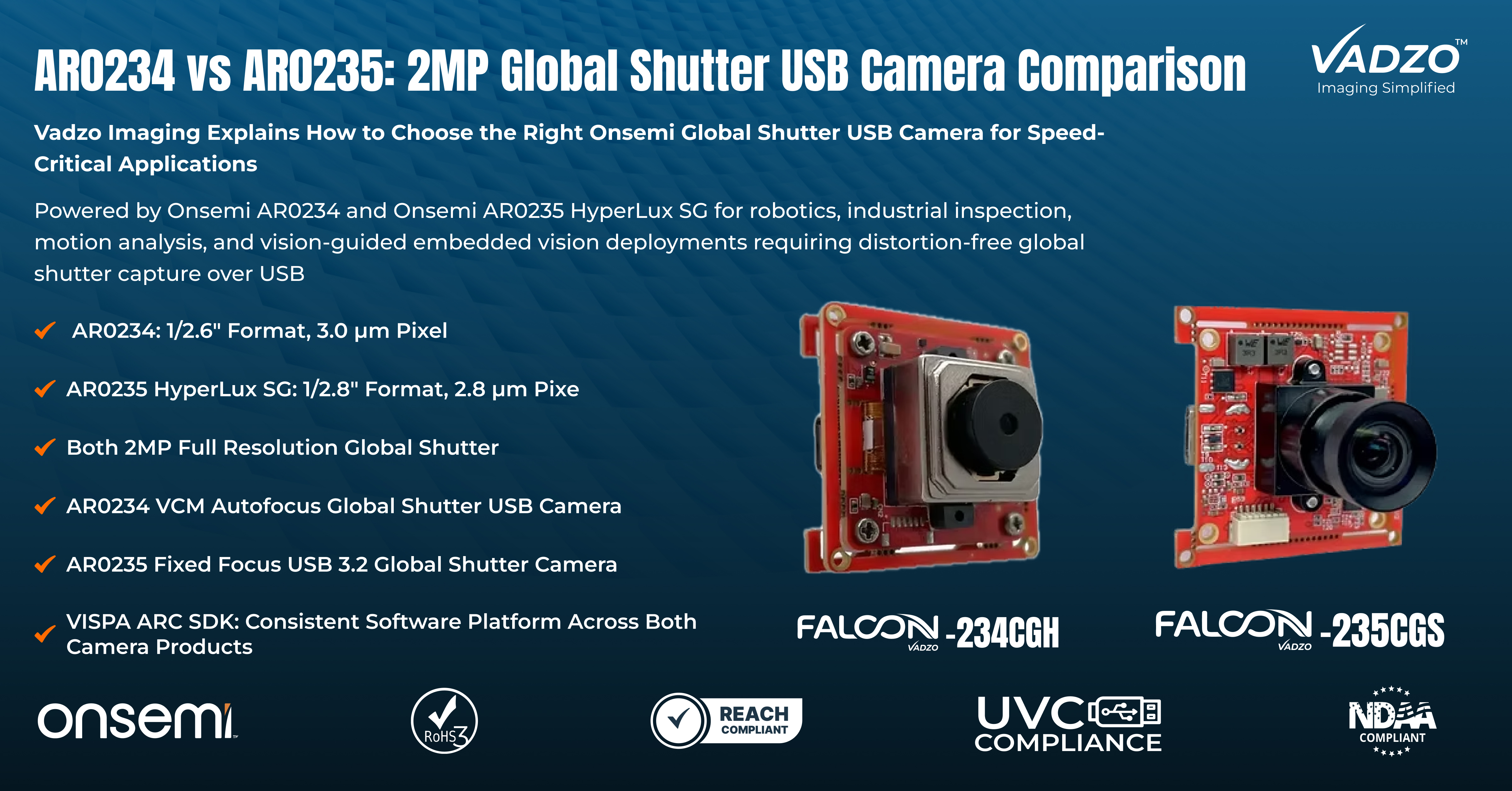
AR0234 Sensor Architecture: Best in Class Global Shutter Efficiency
The Onsemi AR0234 is a 1/2.6-inch CMOS global shutter image sensor with an active pixel array of 1920×1200 and a 3.0 µm pixel pitch. The AR0234 is recognized for best-in-class global shutter efficiency, which directly reduces light leakage between the exposure and readout phases. In precision imaging applications where exposure timing integrity determines measurement accuracy, global shutter efficiency is a sensor-level specification that affects frame quality in ways that dynamic range and SNR figures do not fully capture. The sensor delivers low dark current, high linear full well capacity, and low operational power, making it a stable imaging foundation for embedded platforms with constrained power budgets and applications where thermal consistency across operating cycles matters.
Key sensor specs: Onsemi AR0234 | 1/2.6 inch | 3.0 µm Pixel Pitch | 2MP (1920×1200) | Global Shutter | Up to 120fps | Low Operational Power | -40°C to +85°C Operating Temperature
AR0235 HyperLux SG Sensor Architecture: Sub-2e Read Noise and Superior Low-Light Performance
The Onsemi AR0235CS is a 1/2.8-inch CMOS global shutter image sensor with an active pixel array of 1920×1200 and a 2.8 µm pixel pitch. Part of Onsemi’s onsemi HyperLux SG camera platform, the AR0235 incorporates a global shutter pixel design optimized for accurate and fast capture of moving scenes with superior low-light performance and enhanced NIR sensitivity. The AR0235 delivers a 65.3 dB dynamic range and a maximum SNR of 37 dB with a responsivity of 17.2 ke/lux*s in RGB configuration. The HyperLux SG architecture targets sub-2e read noise, meaning the sensor noise floor is low enough to preserve fine detail in dim imaging conditions where higher read noise would otherwise degrade contrast.
Key sensor specs: Onsemi AR0235 (HyperLux SG) | 1/2.8 inch | 2.8 µm Pixel Pitch | 2MP (1920×1200) | Global Shutter | Up to 120fps (sensor) | Dynamic Range 65.3 dB | Superior Low-Light and IR Performance | On-Chip Auto Exposure | Operating Temperature: -20°C to +85°C
AR0234 vs AR0235: Side-by-Side Specification Comparison
The table below presents the key architectural parameters that differentiate the Onsemi AR0234 and AR0235 at the sensor and camera product level.
|
Specification
|
Onsemi AR0234 | Falcon-234CGH
|
Onsemi AR0235 HyperLux SG | Falcon-235CGS
|
|
Optical Format
|
1/2.6 inch
|
1/2.8 inch
|
|
Pixel Size
|
3.0 µm
|
2.8 µm
|
|
Resolution
|
2MP (1920×1200)
|
2MP (1920×1200)
|
|
Shutter Type
|
Global Shutter
|
Global Shutter
|
|
Full-Res Frame Rate
|
Up to 120fps
|
Up to 120fps (sensor) / Up to 60fps (Falcon-235CGS)
|
|
Dynamic Range
|
Standard
|
65.3 dB
|
|
SNR Max
|
Standard
|
37 dB
|
|
Read Noise
|
Low dark current/hot pixels |
Sub 2e read noise (HyperLux SG)
|
|
Global Shutter Efficiency
|
Best in class (Onsemi specification)
|
Optimized for fast capture and low light
|
|
Low-Light Performance
|
NIR sensitivity, high linear full well
|
Superior low-light and IR performance
|
|
Autofocus (Camera Product)
|
VCM Autofocus (Falcon-234CGH)
|
Fixed Focus (Falcon-235CGS)
|
|
USB Interface
|
USB
|
USB 3.2 (5 Gbps)
|
|
UVC Compliance
|
Yes
|
Yes
|
|
Operating Temperature
|
-40°C to +85°C |
CSP: -20°C to +85°C |
|
SDK Support
|
VISPA ARC SDK
|
VISPA ARC SDK
|
|
Platform Support
|
NVIDIA Jetson, Raspberry Pi, Qualcomm RB, NXP i.MX
|
NVIDIA Jetson, Raspberry Pi, Qualcomm RB, NXP i.MX
|
Key Differences That Define Platform Selection
Pixel Size and Per-Pixel Light Collection: The AR0234 uses a 3.0 µm pixel pitch, delivering a larger photosite area than the AR0235’s 2.8 µm pixel. At equal sensor sensitivity and read noise, a larger pixel collects more photons per unit time, translating to a higher signal at a given illumination level. In applications where controlled illumination ensures an adequate signal at both pixel sizes, this difference is minimal. In variable-illumination environments where strobe power is limited or ambient lighting is inconsistent, the AR0234’s larger pixel provides more signal headroom at the sensor level before noise becomes the limiting factor. The AR0234’s high linear full well capacity also extends this advantage to high-luminance scenes, where deeper charge storage before saturation translates to wider effective dynamic range headroom.
Autofocus versus Fixed Focus: The Camera Product Decision: The most impactful deployment-level difference between Vadzo’s AR0234 and AR0235 camera products is autofocus capability. The Falcon-234CGH implements VCM-based autofocus, enabling the lens to dynamically adjust focus position in response to subject distance changes. This is a system-level differentiator for applications such as retail analytics, where subjects move across a range of distances, robotics vision camera cells that inspect at different arm positions, medical imaging platforms where working distance changes between procedures, and kiosk vision systems where user proximity varies. For these use cases, fixed-focus optics require a design-time distance commitment that may not be feasible across the full deployment lifecycle.
Global Shutter Efficiency: The AR0234 is specified with best-in-class global shutter efficiency, describing how effectively the sensor isolates the storage node from light during the readout phase. In a global shutter, sensor charge accumulates during exposure and must be shielded from further photon influence while the array is read out. Insufficient global shutter efficiency allows light to leak into the storage node during readout, introducing a low-level image artifact that affects scene accuracy in precision measurement and high-contrast inspection tasks. For embedded vision systems where calibration accuracy drives downstream measurement results, global shutter efficiency is not a secondary specification.
Operating Temperature Range: The AR0234 supports an operating temperature range of -40°C to +85°C in Vadzo Imaging’s camera product implementations. The AR0235 CSP package qualifies for -20°C to +85°C with optimal performance between 0°C and +60°C.
NIR Sensitivity: Both platforms deliver NIR sensitivity capability. The AR0235 is specifically noted for superior low-light and IR performance through the HyperLux SG architecture, making it the preferred choice for applications requiring deep NIR sensitivity under dedicated 850 nm or 940 nm illumination.
The Falcon-234CGH: AR0234 Global Shutter Autofocus USB Camera
Vadzo Imaging’s Falcon-234CGH is a 2MP global shutter autofocus USB camera built on the Onsemi AR0234CS sensor. As an AR0234 global shutter camera product, the Falcon-234CGH combines the AR0234’s 1/2.6 inch 3.0 µm global shutter architecture with VCM-based autofocus in a compact board-level module designed for OEM integration.
Key specs: Falcon-234CGH | 2MP (1920×1200) | Onsemi AR0234 | 1/2.6 inch | 3.0 µm Pixel | Global Shutter | VCM Autofocus | USB | UVC Compliant | NIR | S-Mount (M12) | -40°C to +85°C | Windows, Linux, Android | VISPA ARC SDK
The Falcon-235CGS: AR0235 HyperLux SG Global Shutter USB 3.2 Camera
Vadzo Imaging’s Falcon-235CGS is a 2MP color global shutter USB 3.2 camera built on the Onsemi AR0235CS HyperLux SG sensor. As an AR0235 global shutter camera product, the Falcon-235CGS delivers 1920×1200 color global shutter imaging over USB 3.2 in a compact fixed-focus S-Mount module suited for OEM board-level integration. For deployments where subject distance is controlled and low-light imaging quality is the primary differentiator, the Falcon-235CGS applies the AR0235’s sub 2e read noise floor and 65.3 dB dynamic range directly to the application without autofocus mechanical overhead.
Key specs: Falcon-235CGS | 2MP (1920×1200) | Onsemi AR0235 HyperLux SG | 1/2.8 inch | 2.8 µm Pixel | Global Shutter | Fixed Focus | USB 3.2 | UVC Compliant |Superior Low-Light and NIR | S-Mount (M12) | -40°C to +85°C | Windows, Linux, Android | VISPA ARC SDK
“The AR0234 and AR0235 comparison comes up regularly with OEM teams who need to understand where these two sensors sit relative to each other at the system level. The 3.0 µm pixel of the AR0234 and its best-in-class global shutter efficiency make it the right call for harsh-temperature industrial environments, and anywhere VCM autofocus is a deployment requirement. The AR0235 HyperLux SG makes a compelling case where low-light performance needs to be maximized at speed in a controlled-distance setup. Vadzo’s goal is to give teams both options as production-qualified camera products, so the decision comes down to application fit rather than which sensor they can get built into hardware in time.” – Alwin Vincent, Product Manager, Vadzo Imaging.
Applications
Robotics and Vision-Guided Automation: Vision-guided robotics deployments require global shutter capture to prevent motion artifacts during high-speed arm movement and part handling. For robotic cells where the camera must resolve objects at variable distances during arm travel, the Falcon-234CGH provides continuous VCM autofocus adjustment without manual recalibration between depth positions. For structured pick and place cells with fixed working distances, the Falcon-235CGS provides AR0235 HyperLux SG global shutter performance with USB 3.2 bandwidth efficiency and the sub-2e noise floor that supports reliable feature detection in imperfect factory lighting.
Industrial Inspection and Quality Control: Inline inspection systems for PCBs, machined parts, and packaged goods operate with both motion and illumination variation as constants. Where inspection fixtures hold parts at a fixed distance, the Falcon-235CGS applies the AR0235’s 65.3 dB dynamic range and superior low-light capability to consistent defect detection under structured illumination. Where parts are presented at varying heights across multiple product SKUs, the Falcon-234CGH resolves focus position automatically, eliminating per-SKU recalibration overhead that fixed-focus industrial inspection camera systems accumulate in high-mix manufacturing environments.
Motion Analysis and High-Speed Imaging: Capturing high-speed motion events for motion analysis, performance measurement, or product dynamics testing requires a high-speed USB camera that eliminates frame distortion at the sensor level. Both the AR0234 and AR0235 operate at up to 120fps at full 1920×1200 resolution, providing the temporal density needed to reconstruct fast event sequences with sufficient frame overlap for analysis algorithms. The AR0234’s best-in-class global shutter efficiency preserves spatial accuracy at high frame rate camera operation, where any light leakage during readout would degrade the spatial precision that motion analysis camera measurements depend on.
AGV Navigation and Autonomous Mobile Robots: AGV platforms require low-latency imaging camera solutions to maintain navigation accuracy at platform operating velocities. The Falcon-235CGS provides AR0235 global shutter capture with USB 3.2 bandwidth efficiency suited for embedded compute platforms with tight data throughput budgets.
Frequently Asked Questions
Q: What is the difference between a global shutter and a rolling shutter USB camera for speed-critical applications?
A: A global shutter USB camera exposes all pixels in the array simultaneously during a single unified exposure cycle. A rolling shutter USB camera reads the image line by line, beginning at the top row and progressing through the array over a readout period that can span several milliseconds at full resolution. In a scene where the subject or the camera platform is stationary, the difference in output is negligible. In a speed-critical application where either the object or the sensor is in motion during capture, a rolling shutter introduces geometric distortion: vertical subjects tilt, circular objects deform into ovals, and text symbols skew in ways that optical character recognition and inspection algorithms cannot reliably compensate for in software. A barcode label moving at 1 m/s on a conveyor shifts by more than 8mm during the rolling readout window of a 2MP sensor at 30fps, enough to push a narrow barcode bar below the minimum pixel coverage required for reliable decode.
The Falcon-234CGH and Falcon-235CGS represent the two sensor platforms available from Vadzo as complete camera products with validated USB connectivity, VISPA ARC SDK support, and industrial operating temperature ranges covering -40°C to +85°C and -20°C to +85°C, respectively.
Q: How does pixel size affect low-light performance in a 2MP global shutter USB camera?
A: Pixel size is the primary determinant of per-pixel light collection capacity at a given sensor format. Larger pixels have a greater photosite area, collecting more photons per unit time at equivalent illumination levels. This translates to a higher signal at the sensor output before gain amplification, improving signal-to-noise ratio in low-illumination conditions without requiring brighter illumination. The Onsemi AR0234 uses a 3.0 µm pixel pitch in a 1/2.6-inch format, providing a larger individual photosite than the AR0235’s 2.8 µm pixel in the 1/2.8-inch format. The AR0234’s high linear full well capacity extends this advantage to high-luminance scenes where deeper charge storage before saturation translates to wider effective dynamic range headroom.
The AR0235 HyperLux SG compensates through sub-2e read noise, which reduces the sensor’s noise floor contribution at low signal levels. In genuinely dim environments where the scene provides limited photon flux, the AR0235 can maintain cleaner images because its noise floor is lower relative to the incoming signal. In practice, engineers should evaluate the minimum illumination level their deployment will encounter and determine whether the larger pixel of the AR0234 or the lower read noise floor of the AR0235 provides better signal-to-noise performance at that specific lighting condition. Both the Falcon-234CGH and the Falcon-235CGS are available for evaluation with no minimum order requirement, so teams can validate low-light performance in their actual deployment environment with production-qualified hardware before committing to a platform.
Q: Which 2MP global shutter USB camera product is best when the subject distance varies across a robotics or inspection deployment?
A: When subject distance is variable across a deployment, fixed-focus optics force a design-time commitment to a single working distance that may not hold across all operational scenarios. VCM autofocus resolves this by adjusting the lens position in real time to maintain sharp focus regardless of subject depth. For robotics platforms operating across multiple height positions, industrial inspection systems serving multiple product SKUs at different heights, kiosk vision systems where user distance varies, and any embedded camera deployment where camera-to-subject distance changes as a normal part of operation, autofocus capability is a deployment-enabling feature rather than a convenience.
The Falcon-234CGH maintains sharp focus across variable working distances without any host-side intervention, and the VISPA ARC SDK provides API-level autofocus control in C, C++, and Python for applications requiring precise focus management or position-triggered refocusing. The camera’s -40°C to +85°C operating range also covers deployments in outdoor or cold-ambient industrial environments where the AR0235’s -20°C lower temperature floor would be exceeded. Evaluation units are available directly from Vadzo with no minimum order requirement, and the full VISPA ARC SDK documentation is included with each evaluation kit.
Q: What frame rate does a 2MP global shutter camera need for reliable motion analysis and conveyor-based inspection?
A: Frame rate selection for motion analysis and conveyor-based inspection depends on the velocity of the subject and the minimum acceptable displacement over a single frame interval. The fundamental calculation is displacement per frame equals subject velocity multiplied by frame interval. At a conveyor speed of 1 m/s, a 30fps camera allows up to 33mm of subject displacement per frame. At 60 fps, that drops to approximately 16mm. At 120 fps, displacement is under 9mm per frame. For dimensional inspection where a positional error of more than one to two pixels would cause a measurement failure, 120fps global shutter capture at 1920×1200 resolution is the correct baseline requirement. For motion analysis applications, the frame count across a dynamic event determines reconstruction fidelity: a 120fps sensor captures 4x more frames per event interval than a 30fps sensor of equivalent resolution.
The VISPA ARC SDK gives developers direct control over frame rate, exposure timing, and trigger synchronization for acquisition-cycle-accurate inspection pipelines. Vadzo Imaging provides evaluation units for both the Falcon-234CGH and Falcon-235CGS, with no minimum order requirement, enabling engineering teams to validate frame rate and motion capture performance in their actual deployment environment before committing to a production design.
Q: Which 2MP global shutter USB camera works on NVIDIA Jetson and Raspberry Pi for embedded AI and robotics vision?
A: For embedded AI and robotics deployments on NVIDIA Jetson and Raspberry Pi platforms, the most important USB camera integration requirements are UVC compliance for driverless plug-and-play operation, global shutter architecture for motion artifact-free capture, and SDK access for pipeline-level control over exposure, region of interest, and GPIO synchronization. Vadzo Imaging’s Falcon-234CGH and Falcon-235CGS both satisfy all three requirements. Both camera products are UVC compliant and operate natively under V4L2 on Linux-based Jetson and Raspberry Pi systems without custom driver development. The Onsemi AR0234 sensor inside the Falcon-234CGH adds VCM autofocus capability for deployments where working distance is variable across the robot’s operating range, while the Onsemi AR0235 HyperLux SG inside the Falcon-235CGS delivers sub-2e read noise and superior low-light performance for indoor embedded AI deployments where ambient illumination is not controlled.
Both integrate with NVIDIA Jetson Orin series, Raspberry Pi 4 and Raspberry Pi 5, Qualcomm RB series, and NXP i.MX platforms. The VISPA ARC SDK covers C, C++, and Python APIs across Linux, Windows, and Android, giving embedded AI teams consistent programmatic control over both camera platforms from a single SDK interface. For multi-camera perception systems requiring both autofocus and non-autofocus nodes across the same NVIDIA Jetson platform, Vadzo provides both options within the same product family with consistent SDK integration and OEM customization support covering form factor modification, firmware development, lens holder changes, and optical filter integration.
Availability
Both the Falcon-234CGH global shutter autofocus USB camera and the Falcon-235CGS global shutter USB 3.2 camera are available for evaluation and production deployment. Evaluation kits include the camera product, M12 lens assembly, and full VISPA ARC SDK documentation with no minimum order requirement. OEM developers, system integrators, and embedded vision engineering teams can request evaluation units, access detailed technical documentation, and discuss integration requirements directly with Vadzo Imaging’s engineering team to accelerate platform selection and reduce validation time. For technical inquiries or evaluation requests, contact Vadzo Imaging at support@vadzoimaging.com
About Vadzo Imaging
Vadzo Imaging is a global provider of embedded vision solutions delivering high-performance camera technologies and imaging platforms for applications in robotics, industrial automation, UAVs, edge AI, and medical systems. Its camera products are designed for seamless integration with leading embedded platforms such as NVIDIA Jetson, Raspberry Pi, Qualcomm RB series, and NXP i.MX. Vadzo supports customers through hardware customization, firmware development, and its VISPA ARC SDK, enabling faster development and deployment of vision-based systems across USB, MIPI, GigE, Wi-Fi, and SerDes interface platforms.
Media Contact
Alwin Vincent
Vadzo Imaging
Email: alwin@vadzoimaging.com
LinkedIn: Vadzo Imaging
YouTube: Vadzo Imaging
X: Vadzo Imaging
SOURCE: Vadzo Imaging
View the original press release on ACCESS Newswire


